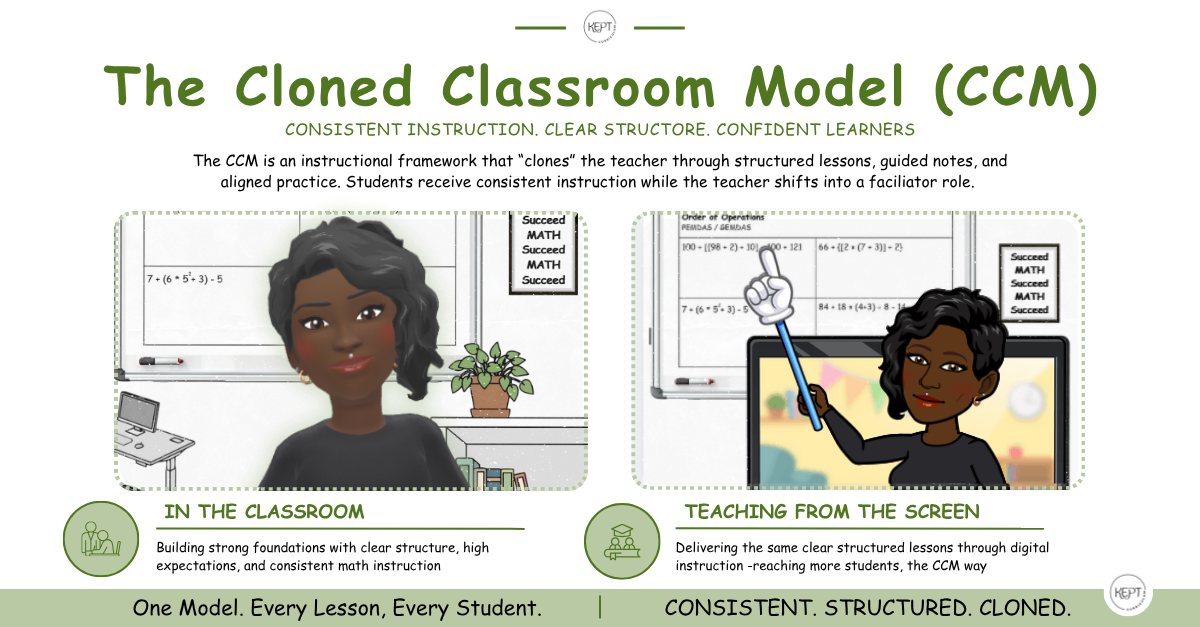
Cloned Classroom Model for every educator
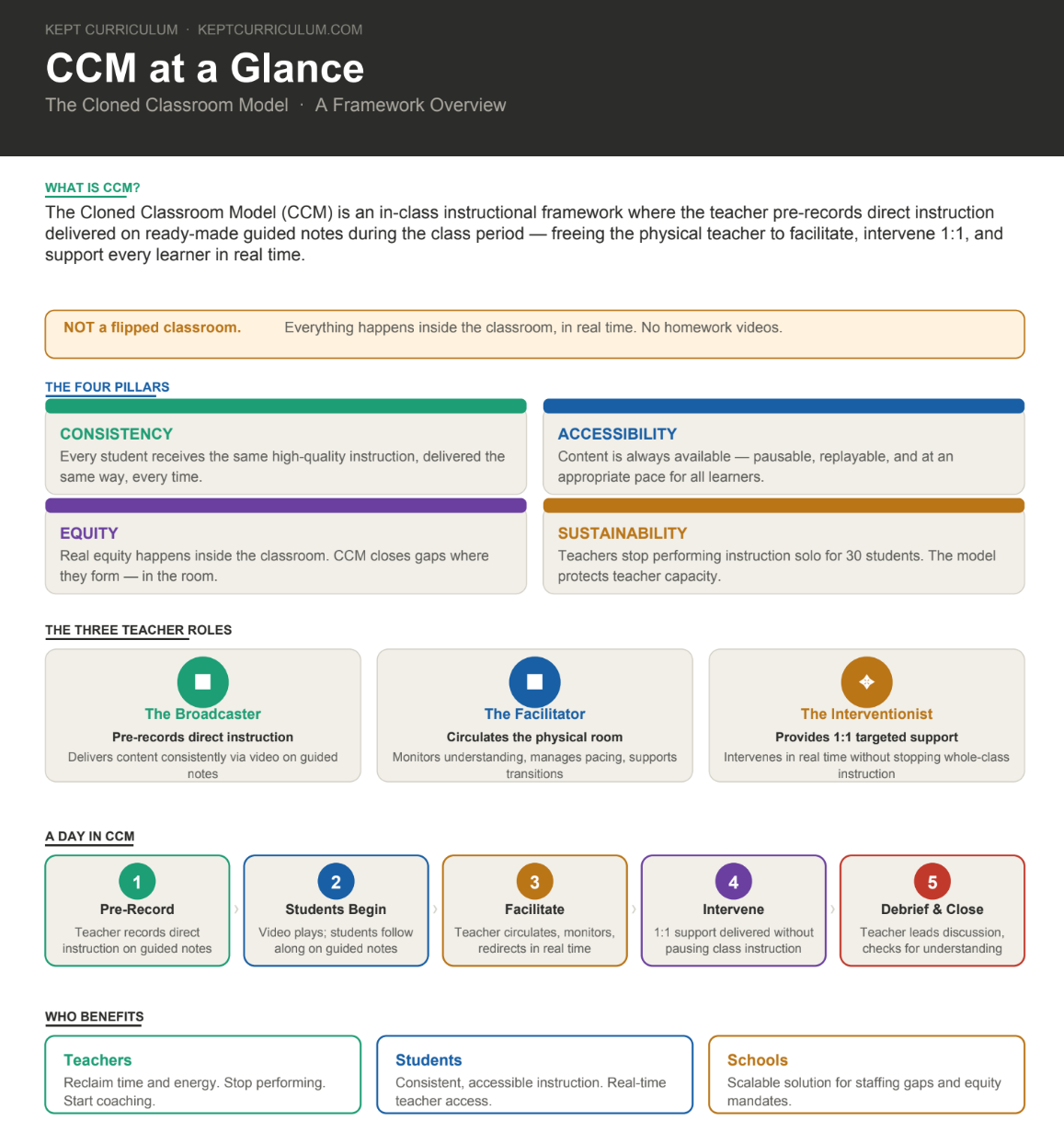
The Cloned Classroom Model is an in-class instructional framework in which the teacher pre-records direct instruction for delivery during the class period, simultaneously providing consistent content delivery to the whole class while freeing the teacher to function as a real-time facilitator, interventionist, and relationship builder — all within the same lesson.
Three Roles of the Cloned Teacher:
The Broadcaster
Video-you delivers instruction consistently, without interruption, to every student at the same time. No student misses the model. No behavior stops the lesson.
The Facilitator
Physical-you moves through the room during instruction, checking guided notes, monitoring engagement, and redirecting off-task behavior quietly.
The Interventionist
Because instruction is handled, you can sit with the student who needs you now, in the moment, before the misconception cements.
The Cloned Classroom Model isn't just a teaching strategy.
It has a name, a definition, a set of pillars, a clear theory of change, and a distinction from existing models in the literature.
Teachers Are Burning Out Because the Model Asks Too Much
I went to school to teach math. I walked into my classroom every morning ready to teach math.
And then I spent 35 minutes a class period doing everything except teaching math.
A "50-minute" middle school class block is a generous fiction. Inside it:
3 minutes corralling. 5 minutes troubleshooting devices. 15 minutes of actual instruction. 20 minutes of "I don't get it" times twenty. 7 minutes of hold-the-line-at-the-door.
That leaves fifteen minutes — sometimes thirty-five on a good day — for the thing the public believes teachers are paid to do.
Then we ask why a child didn't master rational number multiplication in one period.
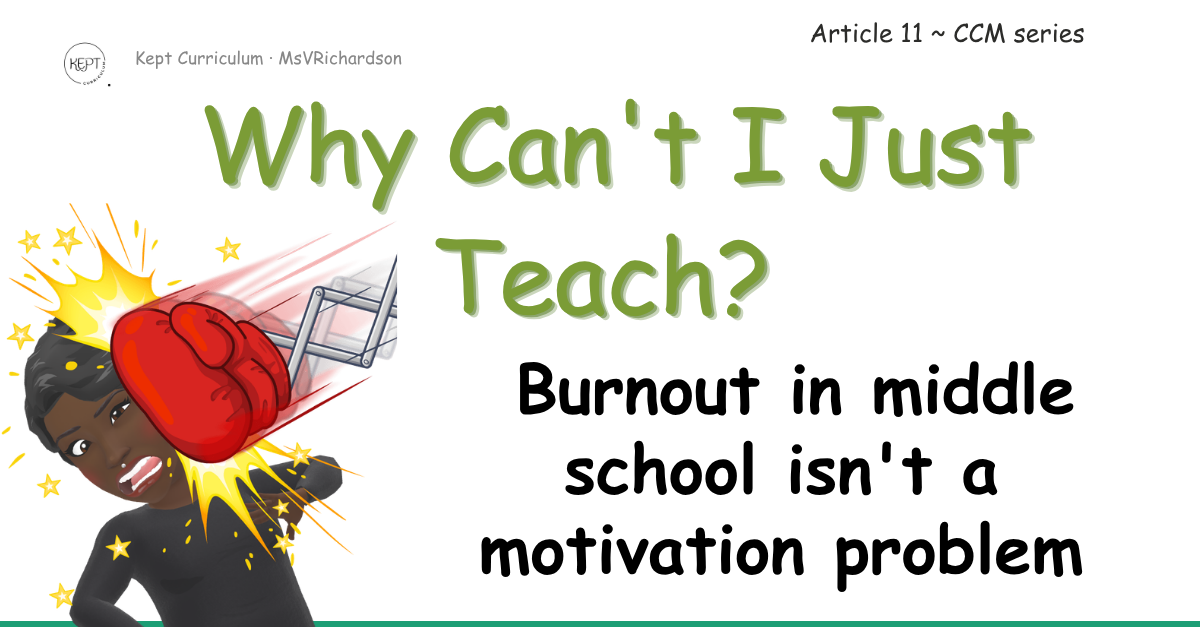
Burnout in teaching is not a motivation problem. It is a job-design problem. And middle school is not the cause of the crisis — it is where the system's design flaws show up first.
In Article 11 of my CCM series, I name what most teachers feel but rarely say out loud:
→ The administrative load that has outgrown the workday → The parent layer that has redefined education as a consumer service → The safety tax most teachers carry alone → Why redesigning the job — not motivating the teacher — is the fix!
If only 15 to 35 minutes of a 50-minute class block is actual teaching — what would you redesign first, and who would have to give something up for that redesign to happen?
#ClonedClassroomModel #CCM #TeacherBurnout #MiddleSchoolMath #KeptCurriculum #EducationInnovation #JobRedesign
What Should Teacher Evaluation Look Like in CCM?
After thirteen years in the classroom, here is the moment that still gets me flagged on an observation.
An evaluator walks in. I am not at the board. I am in a student chair next to a girl who just inverted an operation — three problems into fixing a misconception that would have followed her into the next two weeks of work.
The rest of the room is working. A small group at the back is trading papers, politely arguing about why one of them got a different answer. Two students are stretched out on a beanbag with clipboards. Someone is mouthing along to the lesson video, pausing it to copy a step.
No noise. No chaos. And no teacher voice at the front.
To a traditional walkthrough, this looks like a teacher who lost the room. After thirteen years, I would tell you it might be the most in-control the classroom has ever been.
So why is my rubric still going to score it as a problem?
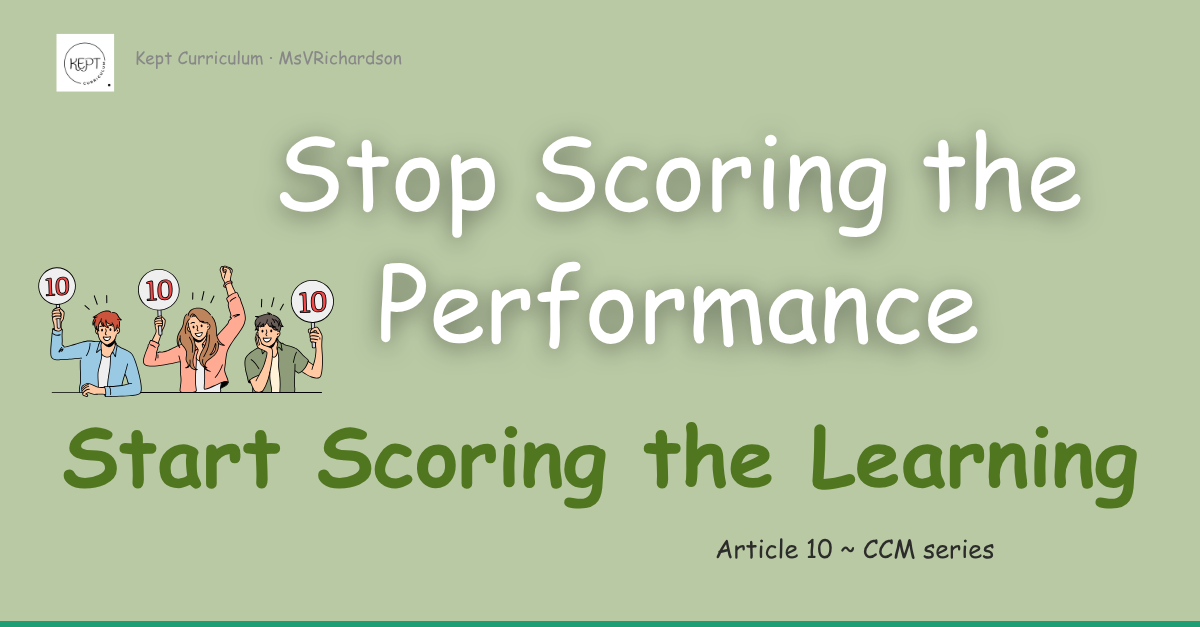
That's the conversation in Article #10 of the Cloned Classroom Model series. The data on teacher evaluation is hard to argue with — and the open door for a better answer is wider than most districts realize.
#ClonedClassroomModel #CCM #TeacherEvaluation #InstructionalLeadership #MathTeacher